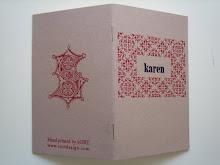
I PATCH is a one-off 14 x 14 cm concertina book made up of ten panels. Each panel consists of a typewritten text in the form of a square measuring 9 x 9 cm. The front and back covers are made of foam board covered with navy Japanese Washi Paper onto which is sewn sixteen hand-stitched squares. Inserted in between the foam board and Washi paper is wadding for a padded effect to create the illusion of a patchwork quilt. Each panel of the concertina consists of handmade paper joined together with a strip of paper measuring 1.5 cm in width. Each side of the strip is hand stitched to one side of two panels. This strip is the bind as well as the fold, which creates the extendable concertina structure. The book is packaged with a pink satin ribbon.


The form plays a part in conveying its concept, as the concertina form draws attention to the craft element of the bookwork through the use of hand stitching. This particular bookwork looks to tie in all elements of book form, which includes the physical form of the object and the form of its content. The squareness of the bookwork both outside and in is made to resemble the square patches of fabric to be found on a patchwork quilt. The title, I PATCH, is not only reflected in the patchworks of the front and back covers but also in the square patches of text within the bookwork. The text is laid out in the form of a square block of text, which visually marks a square patch. It is surrounded by a white border, which further draws attention to the squareness of the text and the object.
The exposed stitch work and binding, hand-cut panels and typewritten text are each a record of production. Stitching and binding are a record of the craft methods employed during the making of the book. The unevenness of hand-cut panels marks the process of production, as does the use of a manual typewriter. The typewriter is a particularly interesting instrument to use as it stains the page with not only letters but also accidental streaks from the ink ribbon. As a writing device it is successful in capturing all the elements of a production process, as mistakes cannot be erased and rewritten. As a manual device the markings are reliant on the artist using it; depending on the pressure placed on the typewriter keys, some letters will imprint the paper darker than others. Equally, each page is fed into the typewriter by hand which means that some words may appear out of line with others. Each of these aspects captures moments of making and to borrow Ulises Carrión’s term; the bookwork becomes ‘a sequence of moments’.
The content is a crisscrossing dialogue between the artist, the book and the reader. It is a dialogue that records the thought processes in those moments of production. Therefore, in the same way that the book form has been constructed as a record of a production, the content also documents aspects of this process. However, instead of a physical record, the text is a mental note that taps into the psyche of the artist at the time of production, to create a bookwork that captures these external and internal processes of making.
The exposed stitch work and binding, hand-cut panels and typewritten text are each a record of production. Stitching and binding are a record of the craft methods employed during the making of the book. The unevenness of hand-cut panels marks the process of production, as does the use of a manual typewriter. The typewriter is a particularly interesting instrument to use as it stains the page with not only letters but also accidental streaks from the ink ribbon. As a writing device it is successful in capturing all the elements of a production process, as mistakes cannot be erased and rewritten. As a manual device the markings are reliant on the artist using it; depending on the pressure placed on the typewriter keys, some letters will imprint the paper darker than others. Equally, each page is fed into the typewriter by hand which means that some words may appear out of line with others. Each of these aspects captures moments of making and to borrow Ulises Carrión’s term; the bookwork becomes ‘a sequence of moments’.
The content is a crisscrossing dialogue between the artist, the book and the reader. It is a dialogue that records the thought processes in those moments of production. Therefore, in the same way that the book form has been constructed as a record of a production, the content also documents aspects of this process. However, instead of a physical record, the text is a mental note that taps into the psyche of the artist at the time of production, to create a bookwork that captures these external and internal processes of making.




![five [yellow] poems](https://blogger.googleusercontent.com/img/b/R29vZ2xl/AVvXsEj7pWNS6-0OLKnVlSKvxNZqflLcymygEpr7SKNZ6DxOw2ujEBwCNVmJyjSNWrwfRduPucxM75xqy150M74MeXwHdLaK8OEy3vX-qNnWPPAj4JQiJA_hiqwlqGsxHqQ9Lzf4ANVHutXo7jRQ/s220/book2.JPG)